
|
NEWS
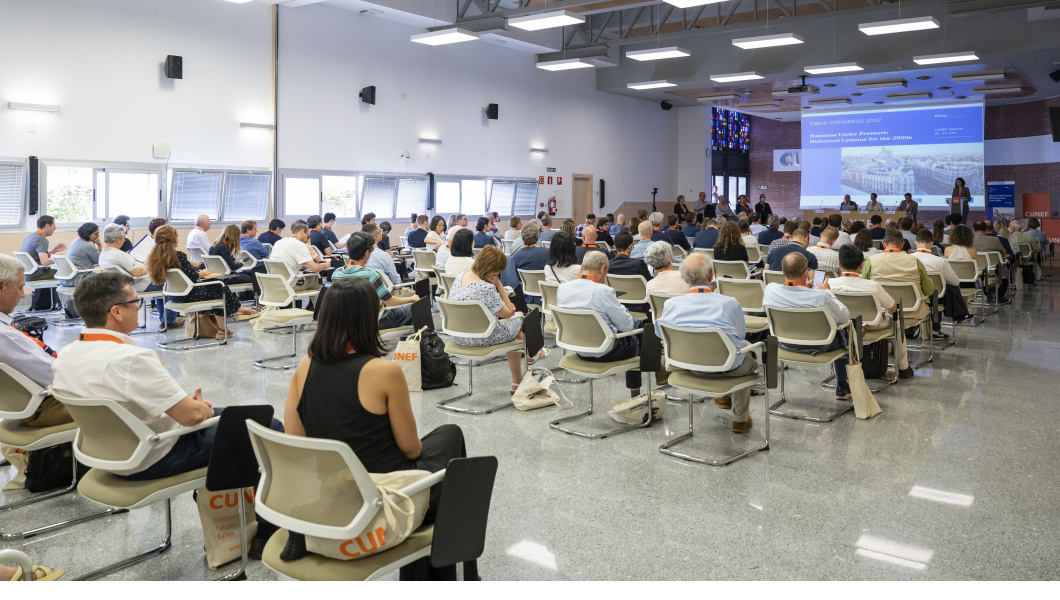
Business History Workshop "Business History in Spain and Europe", Dec. 11-12, 2008 in Barcelona The Economic History Department of the University of Barcelona is pleased to announce the recent constitution of the research centre “Centre d’Estudis en Economia i Història Econòmica Antoni de Capmany”, which strives to promote the study on economic and business history as well as to estimulate academic cooperation with other centers and institutions specialized in such topics. The Centre is organizing its first Business History Workshop “Business History in Following a reception on Thursday afternoon, where David Hiler, State Councillor of the Canton of Geneva, and Yves Flückiger, vice-rector of the University of Geneva, welcomed the participants, the conference was opened on Friday morning by Youssef Cassis, EBHA president, and started with a poignant Memorial to Alfred Chandler, who passed away in May 2007, delivered by Franco Amatori. The conference’s three first sessions, each with six parallel panels, followed in the morning and early afternoon. The participants were then taken to the Palais des Nations for a visit of the building where the League of Nations and, since 1946, the United Nations office at Geneva, have been located. A cocktail was offered there on a terrace offering stunning view over Lake Geneva and Mont-Blanc and in glorious sunshine, which marked the entire conference. The conference’s keynote speech was delivered on Saturday morning by Harm Schröter, who vividly and entertainingly addressed the question of “International Business, Institutional Choice, and the Wealth of Nations”,warning against one sided visions of public policy choices, for instance on cartels, and seeing business and economic historians as best placed to correct this bias. It was followed by a well attended annual meeting of the EBHA. The remaining three sessions also took place on Saturday. The conference ended with a dinner at the Hôtel Beau-Rivage Genève, a suitably grand venue for another great EBHA conference. The School was attended by 21 PhD candidates coming from some of themost important European universities. The topic of this edition of the School was “Writing, Presenting, Publishing: how to make the best use of your own research” and saw the students engaged in debates and discussions with leading scholars in the field of business history. The residential course was supervised by Andrea Colli and Francesca Polese (Bocconi University). The program featured seminars focused on business history theory and methodology, without forgetting about more practical issues such as “publishing strategies”, “how to present a paper” and “teaching with cases”. In their lectures several guest professors addressed their own academic experience thus enriching the summer school: from the opening lectures by Franco Amatori (Bocconi University) about his experience as a “European Chandlerian” to that of the EBHA president Youssef Cassis (“My Business History”). Leslie Hannah (Ecole des Hautes Etudes) reviewed critically his most famous book the Rise of the Corporate Economy -, to the keynote speech, by prof. Matthias Kipping (Schulich School of Business, York University, Toronto), about the identity of business history as a discipline. One of the crucial moments of the school is represented by the presentation and discussion of students’ research projects. According to the students, this is a very useful opportunity both for receiving feedback and insights on their work and for enriching their own studies with a cross national approach and a cross sectional point of view. As in the previous editions, the School has given the possibility to Ph.D candidates to deal with the evolution and recent explorations of the business history; with the discussion of the role of the discipline in the academia and with the analysis of the relationship between business history and other branches, such as history, history of technology, but also economics and management. The week spent at Villalago has created a friendly and informal environment through which students had the possibility to discuss and confront themselves with some academics from the most important international academic institutions and to build a stimulating network among themselves. |
||||